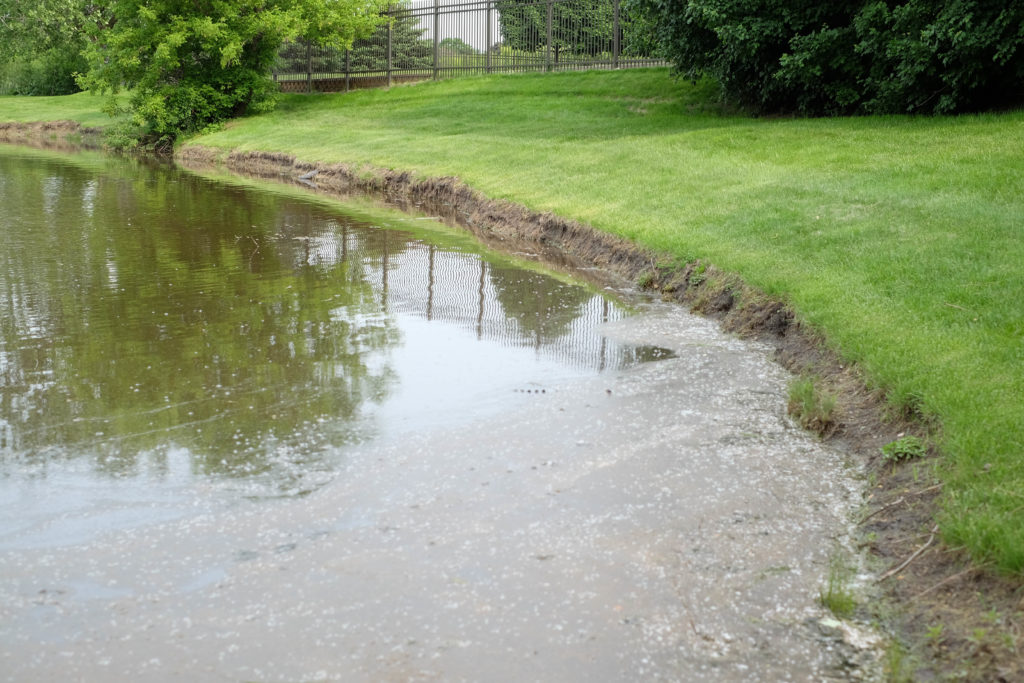
A pond that won’t hold water is frustrating for one simple reason: you can’t see the problem. You just see the waterline falling. The best way to stop wasting time (and money) is to follow one central idea:
Do not pick a “fix” until you know what kind of water loss you have.
Evaporation, seepage, spillway issues, animal burrows, and a failed clay seal all look similar from a distance, but they do not get solved the same way.
This guide walks you through a clean, practical approach to:
Tell if it’s normal loss or a real leak
Narrow down the most likely cause
Match the repair method to the problem
Know when it’s time for professional earthwork instead of another quick patch
Step 1: Separate Normal Water Loss from a Real Leak
Most ponds lose water. The question is whether it’s losing water in a way that makes sense.
What's Normal
Evaporation is the big one. Hot weeks, wind, and full sun can pull water down faster than people expect, especially on shallow ponds with a lot of surface area. Newer ponds can also “seat” and seep for a while until fine particles settle and the soil tightens up.
If your pond drops, then stabilizes after cooler weather or rainfall, it’s often not a structural leak.
What's Not Normal
A true leak behaves differently. It’s stubborn. It keeps going when it shouldn’t.
Here’s the tell: if the pond keeps dropping during cooler weather or after rain and never finds a stable level, assume there’s a leak path.
Step 2: Look for the Three Leak Patterns
Instead of chasing every possible cause at once, start by identifying which “bucket” your pond most likely falls into.
Pattern A: The Pond Drops to a Certain Level and Then Stops
This often points to a leak at a specific elevation, like:
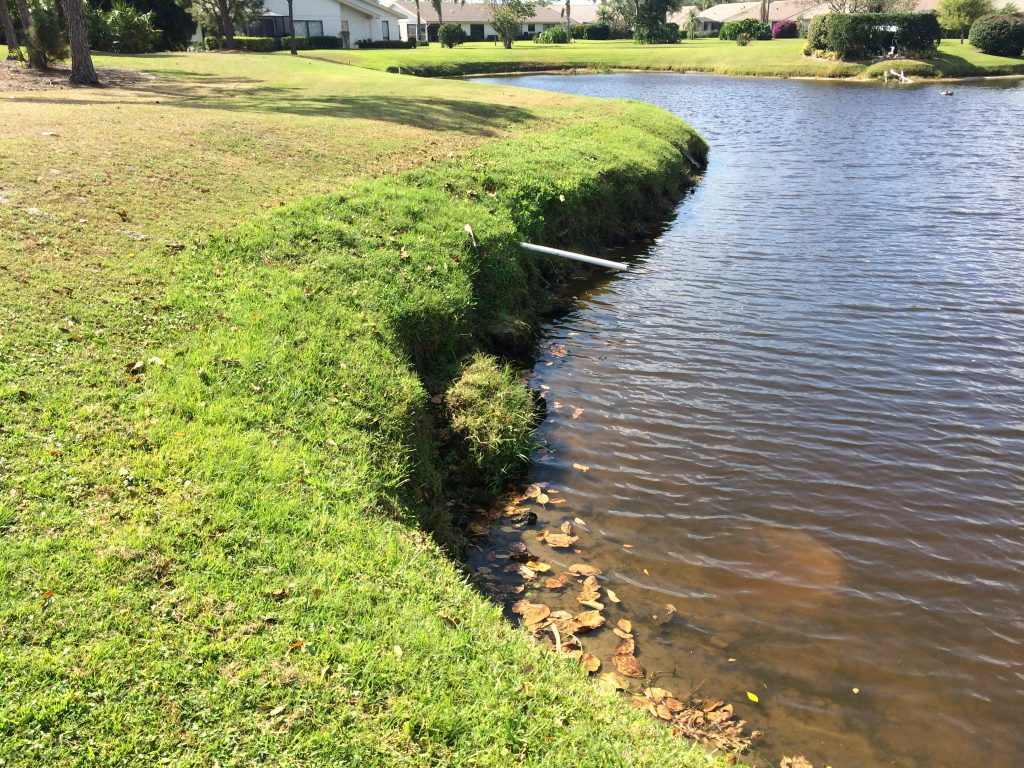
a compromised spot on the shoreline
a seam where different soils meet
a pipe, outlet, or overflow feature at a certain height
It’s a clue that the leak is happening at a “band” around the pond.
Pattern B: The Pond Drops Continuously, Regardless of Level
This is common when the pond bottom or dam/berm is not sealed correctly. Poor compaction, permeable subgrade, or internal voids can let water migrate no matter what the waterline is doing.
Pattern C: The Pond Only "Leaks" During Big Storms
That may not be a leak at all. It can be uncontrolled overflow, spillway erosion, or water bypassing the intended outlet. In those cases, fixing the pond’s sealing won’t help because the problem is how water moves through and around the pond.
This is where stormwater drainage and overflow design matter, and it’s an easy place to connect readers to a drainage/culvert service page later.
Step 3: Do a Simple Check That Actually Helps
You don’t need a lab test to get useful information. You just need one quick comparison.
The Bucket Test (Quick Reality Check)
Fill a bucket with pond water and set it near the pond where it gets similar sun and wind. Mark the water level in the bucket and the pond. Compare after 24–48 hours.
If the pond and bucket drop about the same, evaporation is likely.
If the pond drops noticeably more, you’re likely dealing with a leak path.
This doesn’t diagnose the cause, but it tells you whether you should keep hunting.
Step 4: Walk the Pond Like a Contractor Would
If you want to find the cause faster, don’t stare at the water. Walk the ground.
Check the Downstream Side of the Dam or Berm
A wet strip or soggy area downhill from the pond is one of the most important signs. Persistent moisture behind a dam can mean water is traveling through the embankment. That’s not a “throw a product at it” problem.
Look for Soft Spots, Sinkholes, or Settling
Small depressions near the dam or shoreline can indicate voids forming under the surface, sometimes from decaying organic material or burrows.
Scan for Animal Activity
Muskrats are the usual suspects. Their burrows can create a clean channel that drains water faster than you’d expect. If you find holes near the waterline or tracks and slides, treat it as a likely cause.
Pay Attention to the Spillway and Overflow Path
If the spillway is eroding, undercutting, or bypassing, water can carve new routes that saturate banks and create “leak-looking” conditions.
The Most Common Causes of a Leaking Pond
You’ll see a lot of theories online. In the field, most leaking ponds come back to a short list.
1) Poor Compaction During Construction
A pond seal is not just “having clay.” It’s having clay that was compacted correctly. If the pond bottom or dam was shaped without proper compaction (or built too wet, too dry, or in thick lifts), water can migrate through seams and voids.
This is also why some ponds leak years later. The weakness was always there. It just takes time to show itself.
2) Permeable Soils That Won’t Seal Naturally
Some sites have sand, gravel lenses, or fractured rock that let water move. Even if the surface looks like it has clay, one permeable layer underneath can drain a pond slowly and consistently.
3) Buried Organic Material Breaking Down Over Time
If brush, roots, or topsoil was left under the pond bottom or inside the embankment, it can decompose and leave voids. Water finds those voids fast.
4) Muskrat and Animal Burrows
This is the “sudden drop” culprit. Burrows often show up as:
unexplained water loss
a wet area behind the dam
new soft spots near the shoreline
If burrows go through the dam, the repair usually needs excavation and recompaction to be reliable.
5) Spillway, Outlet, or Overflow Problems
If water is leaving where it shouldn’t, it may not be a sealing problem. It may be a design or erosion problem. Fixing this often requires grading and stabilization, sometimes with riprap.
6) Sediment Buildup and Shallow Pond Behavior
A pond that’s filled in with silt behaves differently. It warms faster, evaporates faster, and saturates the edges more easily. It can also expose weak shorelines and create constant muddy areas that get mistaken for a leak.
Solutions That Actually Stop a Pond From Leaking
Once you know where the water is leaving and why, the fix usually becomes clear. Most pond repairs fall into a small number of categories. The key is matching the solution to the problem instead of reaching for a one-size-fits-all product.
Recompaction & Clay Sealing
Best for: seepage through the pond bottom or dam, poor original construction, long-term water loss.
If a pond was never compacted correctly, water will keep finding paths through the soil. In those cases, the most reliable fix is rebuilding the seal itself. That often means dewatering the problem area, removing soft or organic material, and recompacting clay in controlled lifts.
This approach addresses the root cause and is why properly built ponds hold water for decades.
Bentonite (When Conditions Are Right)
Best for: specific soils with minor seepage and otherwise sound structure.
Bentonite can work, but only when soil conditions, preparation, and application are right. It helps tighten fine pores in clay-rich soils. It does not fix voids, burrows, or seepage through a dam.
If there’s evidence of dam saturation or animal activity, bentonite alone is rarely a lasting solution.
Liners and Engineered Sealing Systems
Best for: highly permeable soils or repeat sealing failures
In sites where clay sealing isn’t feasible, liners can provide a dependable barrier. The success of a liner depends less on the material and more on the prep beneath it. Poor grading or sharp subgrade conditions can shorten its life quickly.
Spillway and Overflow Corrections
Best for: water loss tied to heavy rain, erosion, or uncontrolled overflow.
Sometimes the pond isn’t leaking at all. Water is simply leaving where it shouldn’t. Regrading spillways, stabilizing outlets, or improving overflow control can stop ongoing erosion and prevent future damage.
Full Pond Reclamation
Best for: older ponds with sediment buildup, poor depth, multiple failure points, or repeated patch attempts.
When a pond has lost depth, won’t hold water, and has been repaired several times without success, reclamation is often the most cost-effective long-term fix. This combines sediment removal, reshaping, sealing, spillway work, and bank stabilization into a single, durable solution.
A Simple Rule of Thumb
If the problem is surface-level and shallow, some targeted solutions may help. If the problem is structural, below the surface, or tied to the dam, reliable repairs usually involve excavation, compaction, and grading.
That distinction alone eliminates most trial-and-error fixes.
When To Stop DIY-ing & Involve An Expert
Here are the situations that usually require equipment and a real plan:
Wet ground behind the dam or berm that doesn’t dry out
Evidence of burrows or voids
A pond that never stabilizes, even after rain
Spillway erosion or overflow bypassing the intended outlet
Sediment buildup that has changed the pond’s depth and behavior
Past repairs that worked briefly, then failed again
At that point, the best next step is not another product. It’s figuring out whether the fix is sealing, rebuilding, drainage correction, or full reclamation.
Leaking Pond FAQs
How much water loss is normal for a pond?
Some water loss is normal, especially in hot, windy weather. If the pond stabilizes after rain and cooler weeks, evaporation is likely. If it keeps dropping no matter what, suspect a leak path.
Do I have to drain my pond to fix a leak?
Not always. Minor issues near the shoreline can sometimes be addressed without full dewatering. But structural repairs to the pond bottom or dam usually require access to the problem area, which often means partial or full dewatering.
Can muskrats cause serious pond leaks?
Yes. Muskrat burrows can create channels through banks and dams that allow water to escape. If burrows go through the embankment, reliable repairs usually involve excavation and proper recompaction.
Is clay better than a liner?
Clay can be a great long-term seal when it’s compacted correctly and there’s enough clay content. Liners can work well in permeable soils but require strong prep and protection to last.
When does a pond need full reclamation?
When the pond is shallow from sediment, won’t hold water, and has been patched repeatedly, reclamation is often the cleanest long-term reset.
A Simple Next Step
If your pond isn’t holding water, ICON Grading can help identify what’s actually going wrong and what it will take to fix it. Our team evaluates where water is escaping, how the pond was built, and whether the right solution is sealing, drainage and spillway work, or full pond reclamation. A site visit gives you clear answers and a realistic path forward, without guesswork or repeat fixes.
More Articles

Load More