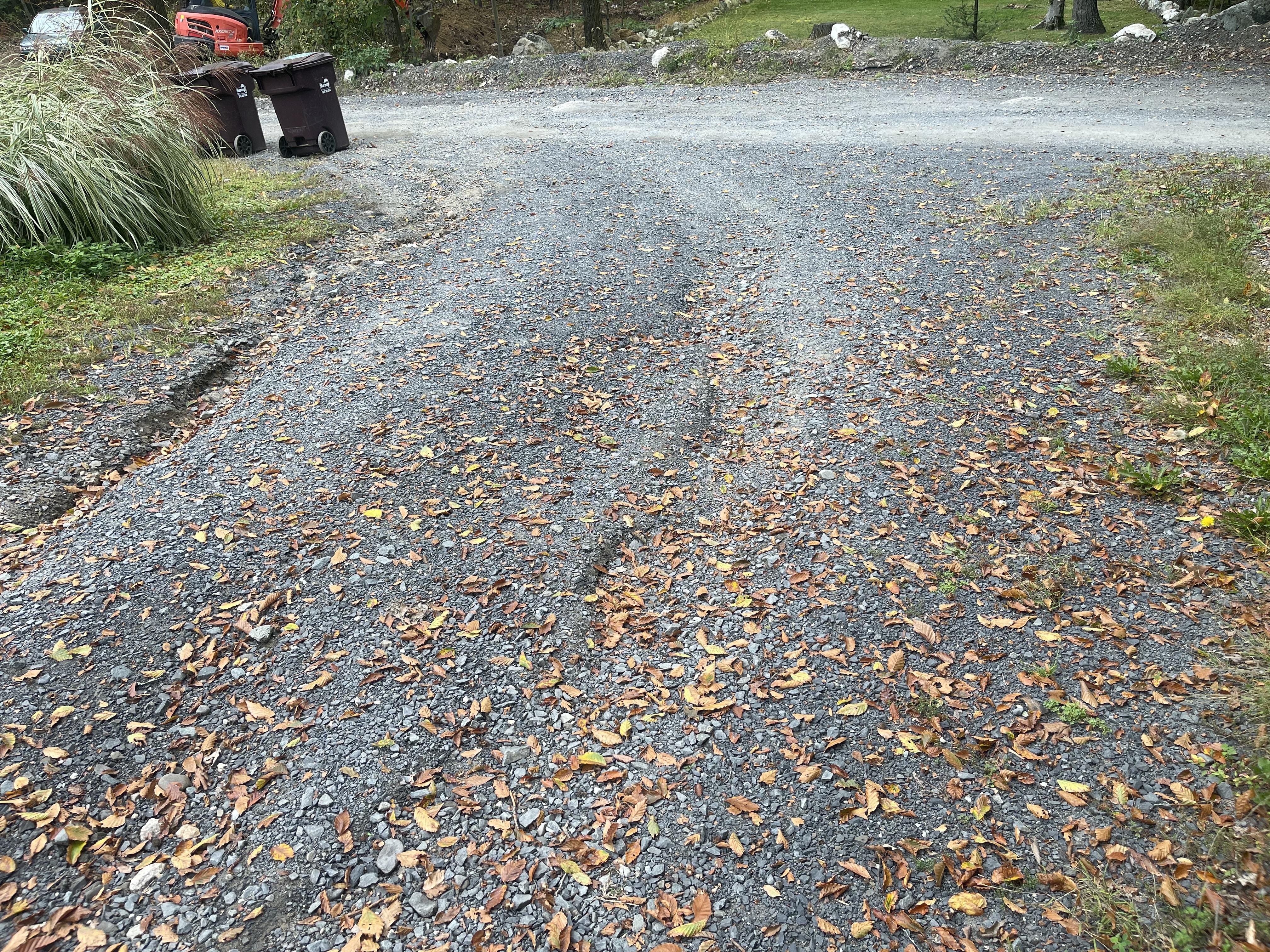
Ruts come back weeks after adding fresh gravel. Money gets spent on new rock and grading, yet the tire tracks return in the same locations after the next rain. In the Kansas City metro, clay-heavy soils and poor drainage make that cycle expensive and predictable.
Most recurring gravel driveway rutting is not a surface problem. It is a moisture and subgrade strength issue. By the end of this article, you will be able to identify what the symptom actually means and determine whether the fix is regrading, drainage correction, or structural rebuild.
What Gravel Rutting Usually Means Structurally
When ruts keep forming in the same wheel paths, the issue is not gravel thickness. It is subgrade deformation.
Gravel distributes load. It does not create strength on its own. The strength comes from the compacted soil layer underneath. In Kansas City clay soils, once moisture content rises, bearing capacity drops quickly. That is why rutting often worsens after rainfall rather than during dry conditions.
If a loaded truck drives over the area and you see visible deflection or pumping, the subgrade is failing. At that point, adding more aggregate only increases weight on a weakened layer.
The correction starts with confirming stability through proof-roll. If deflection exists, the solution shifts toward undercut, stabilization, or separation before new base is placed.
The Three Most Common Rut Causes
1. Saturated Clay Subgrade
Kansas City soils often contain high clay content. Clay holds moisture and weakens when saturated. When traffic runs over wet clay, the soil pumps and shifts.
Field indicators
Mud pushing up through gravel
Soft, spongy feel under tires
Ruts that return within weeks
Cause
High moisture content
Inadequate compaction during original build
Traffic loading on softened clay
Structural correction
Proof-roll to identify deflection
Undercut unstable sections
Consider lime or cement stabilization for broad soft zones
If the base pumps under a loaded truck, it is not stable. That is not corrected with additional stone.
2. No Drainage Control (Crown, Swale, Culvert)
Flat driveways trap water. Without crown or cross-slope, water sits in wheel paths and infiltrates the base.
Field indicators
Standing water after moderate rainfall
Water running down tire ruts instead of off the surface
Clogged or undersized culverts
Cause
No defined crown
Improper ditch depth
Drainage path blocked or poorly graded
Structural correction
Re-establish crown at 2–4 percent cross-slope
Clean or replace culverts
Cut functional swales to move water away from the drive
Drainage must be corrected before rebuilding base. Placing new aggregate on a flat surface traps water in the same pattern.
3. No Separation Layer Between Soil and Gravel
Without separation, gravel and clay mix under traffic. The base loses thickness and structural value.
Field indicators
Clay visible within aggregate when scraped
Base thinning despite repeated rock additions
Ruts widening over time
Cause
No geotextile under gravel driveway
Traffic forcing fines upward into aggregate
Structural correction
Strip contaminated base
Install woven geotextile separation
Rebuild aggregate in controlled lifts and compact each layer
Separation prevents fines migration. Without it, the driveway slowly converts into mud with rock mixed in.
Why Adding Rock Fails
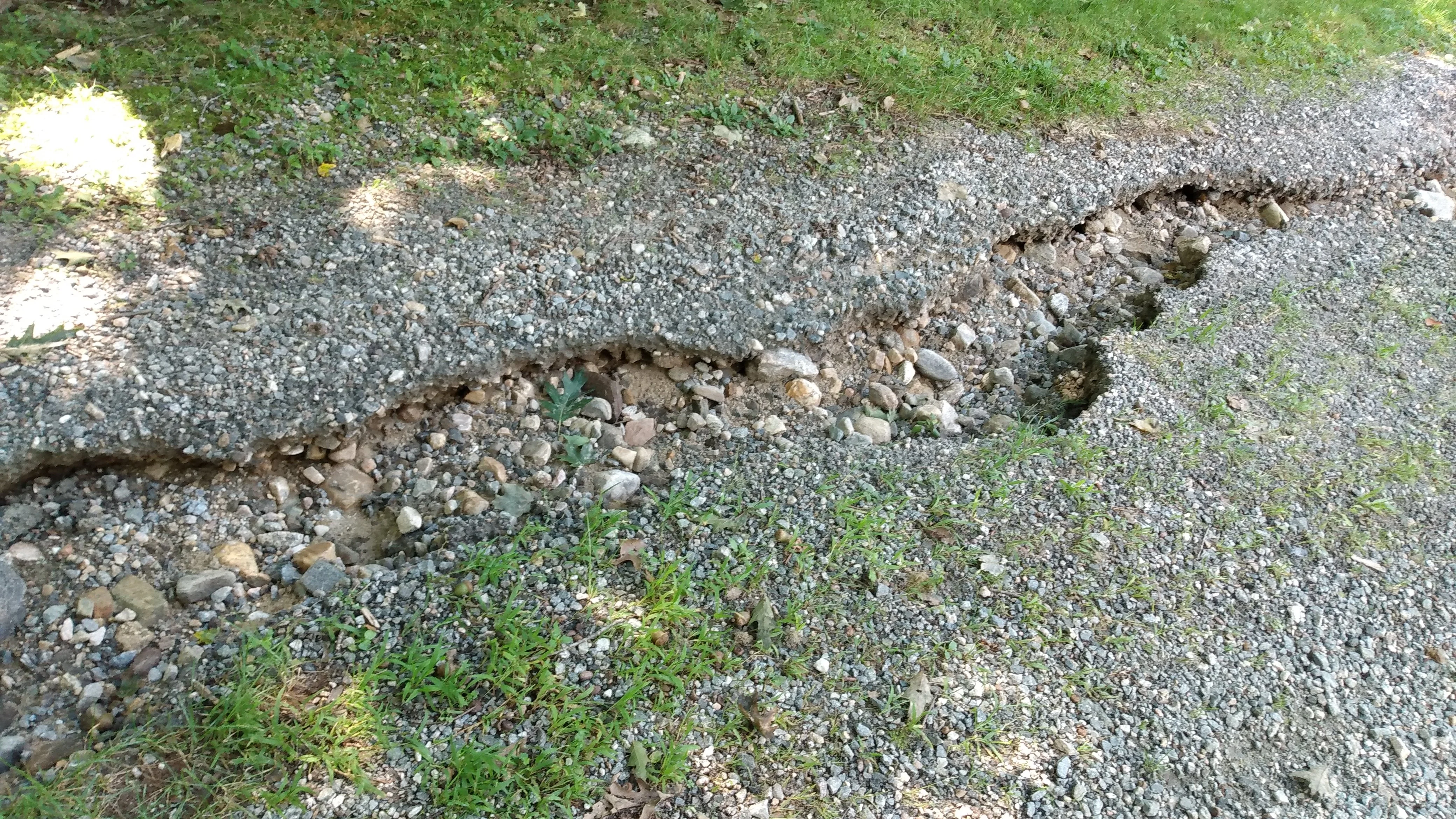
Adding gravel improves appearance because it fills the rut. It does not change the soil strength beneath it.
The new rock compresses into the same weak layer. After the next rainfall or heavy traffic cycle, the rut reappears in the identical path.
If improvement lasts only a few weeks, that is confirmation the base layer is not structurally sound.
A lasting fix requires changing one of three things:
Subgrade strength
Drainage pattern
Separation between soil and aggregate
If none of those change, performance does not change.
Surface Fix vs Structural Fix (When Each Applies)
Minor washboarding or shallow displacement can be corrected with regrading. Deep recurring ruts require structural work.
Condition | Surface Regrade Works | Structural Fix Required |
Light washboarding | ✔ | |
Ruts deeper than 3 inches | ✔ | |
Pumping under load | ✔ | |
No crown present | ✔ | |
Clay mixed in aggregate | ✔ |
If gravel driveway rutting causes are limited to poor crown or minor displacement, regrading may be sufficient. If pumping or saturation is present, structural rebuild becomes necessary.
What a Correct Structural Fix Looks Like
A proper rebuild follows sequence. Skipping sequence recreates failure.
Work typically proceeds as follows:
Remove unstable or contaminated aggregate.
Proof-roll to identify weak subgrade zones.
Undercut areas that show deflection.
Install geotextile where soil conditions warrant separation.
Place aggregate in controlled lifts.
Compact each lift to target density.
Establish consistent crown and drainage flow.
Compaction matters. Dumping full-depth aggregate without lift control prevents uniform density. Moisture conditioning also matters. Aggregate placed too dry or too wet will not achieve target compaction.
This is where undercut or stabilization becomes necessary. Our Driveway & Private Road Repair service addresses these structural corrections when surface grading alone does not resolve recurring rutting.
When properly rebuilt, the driveway will not deflect under load, and water will shed off the surface rather than sit in wheel paths.
Undercut vs Stabilization vs Geotextile (Decision Guide)
Different failure types require different solutions. The choice depends on depth and moisture condition.
Undercut is used when soft soil extends several inches or more below grade. Unstable material is removed and replaced with compacted structural fill. This resets bearing capacity.
Stabilization is appropriate for widespread clay softness without deep organic pockets. Lime or cement treatment reduces plasticity and increases strength. Proper mixing and curing are required.
Geotextile is effective when soil is weak but not deeply unstable. It prevents fine migration and maintains aggregate thickness over time.
If pumping is visible during proof-roll, undercut is likely required. If clay is plastic but shallow, stabilization may be more efficient. If mixing is the primary issue, separation may be sufficient.
Long-Term Performance Thinking
Repeated top-offs create cumulative cost. Material, trucking, and grading add up over years. Structural correction reduces seasonal maintenance. Proper drainage prevents water from softening the base again.
Failure to address subgrade strength can spread rutting outward. Once water pathways establish, erosion increases and edge failure follows.
Performance is determined by base support and drainage control, not surface appearance.
When to Call a Contractor
Ruts deeper than 3–4 inches
Visible pumping during traffic
Driveway remains wet days after rainfall
Culvert or ditch failure contributing to saturation
Multiple unsuccessful gravel additions
If repeated subgrade failures are present, a short site visit can clarify whether the issue is drainage, compaction, or structural soil weakness.
Driveway Rut FAQs
Can I just add more gravel?
Only if the base is stable and drainage is functioning. If ruts return in the same locations, the subgrade strength has not been corrected.
How do I know if it’s drainage or soil?
Standing water and flat grades suggest drainage. Pumping and soft deflection under load indicate subgrade weakness.
Do I need to excavate the entire driveway?
Not always. Localized failures may only require spot undercut. Widespread rutting usually signals broader structural correction.
Why does it keep coming back?
Because the load-bearing layer remains weak. Surface material cannot compensate for saturated or poorly compacted soil.
What affects cost most?
Depth of undercut, length of driveway, drainage corrections, and material volume. Structural extent drives scope.
Having Subgrade Problems in Kansas City? Call Us!
If your roadway section in the Kansas City area keeps failing proof-roll, pumping, or turning soft after rain, call ICON. We’ll do a site visit, pinpoint what’s failing, and recommend the right fix, whether that’s undercut, stabilization, geotextile separation, drainage, or a combination. Get a Site Visit & Quote
More Articles

Load More