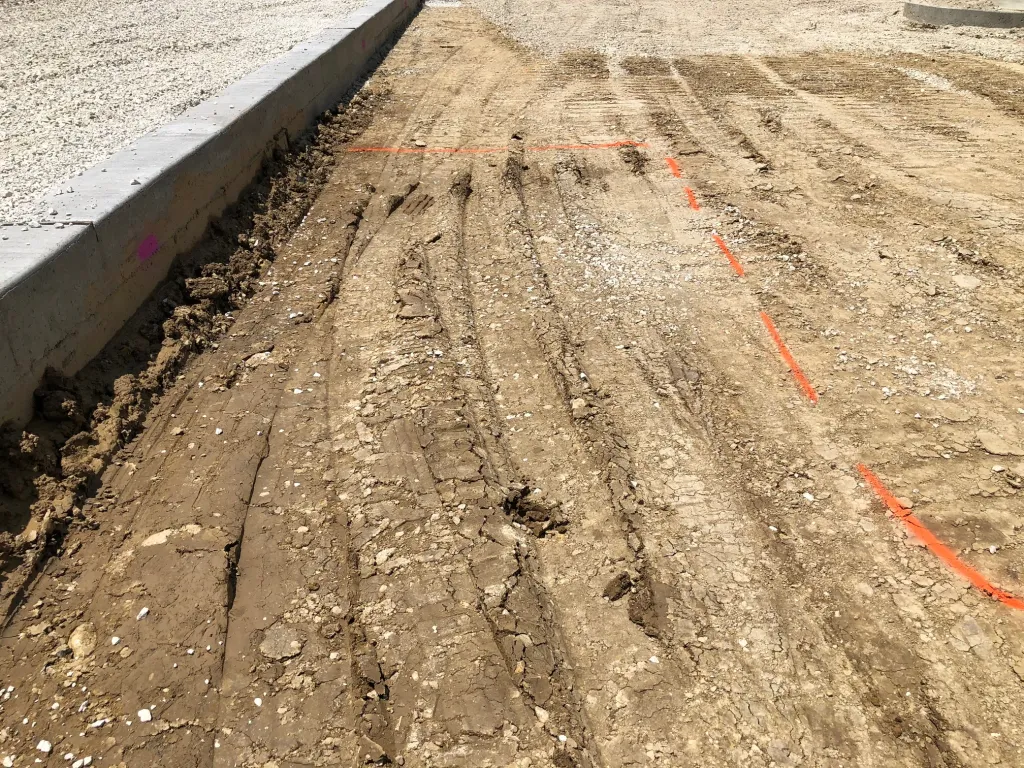
The pad passed proof-roll and paving was next in line during roadway prep. Then rain moved through, and the same area began pumping under load. Now the schedule is uncertain.
In Kansas City, the explanation usually involves moisture-sensitive clay and incomplete drainage control. The failure is predictable once the soil absorbs water.
We'll outline what that pattern means in the field and how to address it structurally, so your subgrade holds up long-term.
A Proof-Roll Is a Snapshot, Not a Guarantee
Proof-rolling tells you how the subgrade behaves under load at that moment. It does not predict how it will perform after moisture content shifts. Clay in this region often compacts near optimum moisture and meets density targets. Once rainfall pushes it past that range, shear strength drops quickly. The subgrade may still look intact, but under load it deflects and pumps.
If a tri-axle leaves shallow ruts after rain where it left none before, the soil has moved outside its stable moisture window. That is a soil response, not simply a compaction issue.
The correction starts with re-evaluating moisture and drainage, not with more rolling.
Kansas City Clay Holds Water Longer Than You Think
These soils do not drain like sandy material. Water infiltrates slowly and tends to linger. Even when the surface appears dry, moisture can remain trapped a few inches below.
On many sites, soft bands form along low edges or where temporary grading directs runoff. A pad that shed water poorly during construction will show weakness first in those areas. Sometimes the failure follows utility trench lines where backfill was placed in thicker lifts.
This pattern is consistent with plastic clay that absorbs water, swells, and reduces bearing capacity. Once saturated, it does not regain strength immediately when the surface dries.
If water has no clear path off the site, the problem repeats after every meaningful rain event.
Why More Rock Does Not Fix Weak Subgrade
Adding aggregate feels productive because it firms up the surface temporarily. Under load, though, saturated clay pushes into the stone. The base begins to blend with the subgrade. You will see rock disappearing, mud pumping up between aggregate, and ruts reforming in the same traffic paths. That is not a base thickness problem. It is a support problem.
Letting the area dry may allow work to continue briefly. The next rain resets conditions. Rolling harder increases movement in wet clay and can worsen pumping.
When the subgrade fails after rain, the solution is below the aggregate layer.
What to Look At Before Deciding on a Fix
Start by isolating whether the issue is localized or widespread. If only a low strip or trench line softens, drainage or backfill compaction is likely contributing. If the entire pad softens uniformly, moisture-sensitive clay is the driver.
Check the soil directly. If it ribbons and smears easily in your hand, plasticity is high. That means strength changes quickly with moisture.
Review how the subgrade was built:
Were lifts placed and compacted in controlled thickness?
Was moisture conditioned before compaction?
Were swales, cross-slope, and ditch lines complete before heavy traffic?
Subgrade that was rushed into shape without proper moisture control is more likely to fail after rain. Subgrade that cannot shed water will not stay stable.
What Structural Correction Actually Involves
The first step is to stop building upward. Placing additional base over unstable soil traps moisture and complicates repair.
If drainage is contributing, correct it first. Adjust crown or cross-slope, complete the swale, and ensure water leaves the pad instead of collecting along the edge.
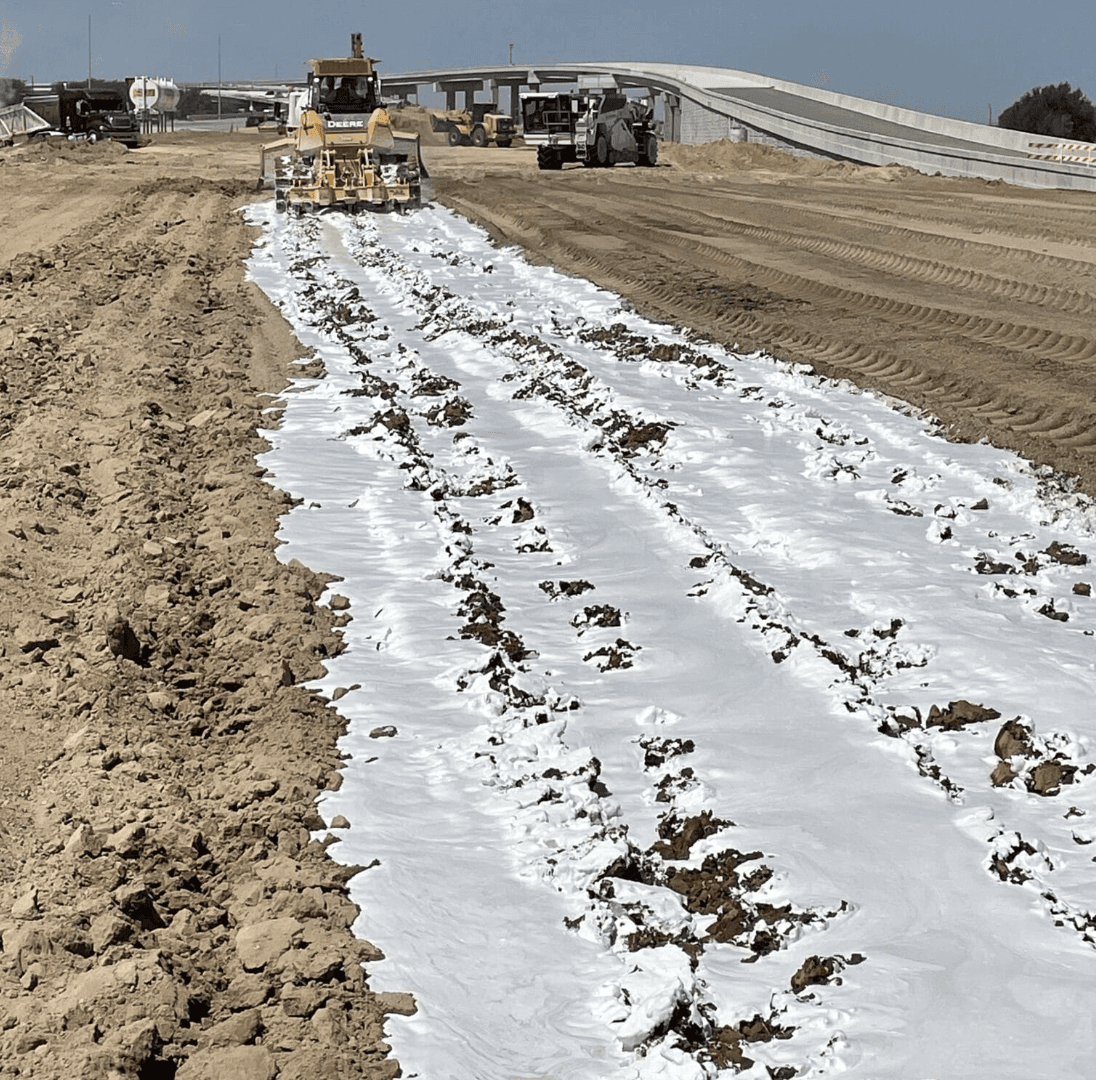
If the clay itself cannot maintain strength within workable moisture ranges, stabilization may be required. Treating high-plasticity soil reduces its ability to swell and improves load-bearing performance. After treatment, the soil must be reworked and compacted in controlled lifts, then proof-rolled again before aggregate is placed.
If instability extends deeper than stabilization can address, undercutting becomes necessary. Unsuitable material is removed to stable depth and replaced with compacted structural fill. Geotextile may be added for separation, but it does not replace structural correction.
This is where subgrade stabilization becomes a structural decision, not a cosmetic one.
Choosing Between Undercut and Stabilization
Undercut is typically the right call when soft material extends deep or when organics are present. If the subgrade continues to deflect under moderate load even after drying, removal is often the most reliable path.
Stabilization makes sense where clay is broadly weak but not excessively deep. It modifies soil behavior in place and can be efficient across large pads.
Geotextile has a role, but only as separation within a properly designed system. It will not compensate for saturated, low-strength clay beneath it.
The decision depends on depth, extent, and drainage. A short evaluation on site usually clarifies which approach avoids repeated correction.
Why This Matters Before Paving
Subgrade performance controls what happens above it. If aggregate is placed over unstable soil, the base layer becomes contaminated and uneven. That movement transfers into asphalt or concrete.
Cracking, settlement, and edge failure often trace back to subgrade that passed proof-roll once but was never stable through moisture cycles.
Correcting the issue before paving protects schedule and long-term performance. Replacing a failed base after paving is more disruptive than addressing soil behavior early.
When a Site Visit Makes Sense
Repeated pumping after rain, rock blending into clay, or ruts that return with each storm indicate that moisture sensitivity or drainage flow is unresolved.
At that point, the focus shifts from surface repair to structural evaluation. Soil type, moisture range, drainage path, and compaction sequencing all need to be reviewed together.
If you are seeing this pattern, a short site visit can usually determine whether drainage correction, stabilization, or undercut is the right path forward.
Frequently Asked Questions
Can I just wait for it to dry and keep moving?
Drying may temporarily restore firmness. If the soil is highly plastic, the same weakness often returns after the next significant rainfall.
Does failing proof-roll mean the entire site is bad?
Not necessarily. Some failures are confined to low areas or trench lines. Others reflect broader clay sensitivity. The pattern of movement usually indicates which.
Is adding more base ever the solution?
Additional base can help distribute load if the subgrade is stable. It does not correct saturated clay that is losing shear strength.
How do I know if I need undercut instead of stabilization?
Depth of instability and soil composition determine that choice. Persistent deep deflection often requires removal, while widespread shallow weakness may be treated in place.
Why does the problem keep coming back after rain?
Because moisture sensitivity or drainage flow has not been corrected. Until the soil behavior is addressed, rainfall will continue to trigger the same response.
More Articles

Load More