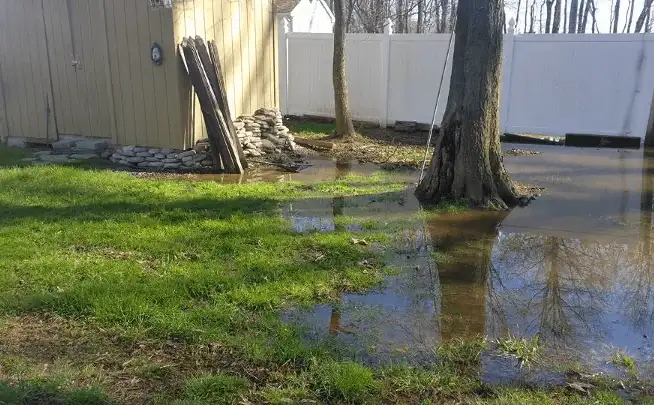
Standing water on a recently completed site is rarely a result of extreme weather. It is typically a mechanical failure in the transition between rough site prep and the final surface. When ponding occurs, it creates immediate risks for foundation saturation and hydrostatic pressure against basement walls.
Ignoring these symptoms leads to soil expansion and the eventual failure of expensive landscaping or flatwork. This guide clarifies why standard "rough grades" fail to shed water and how technical finish grading prevents long-term property damage.
The "Bathtub Effect": Why New Foundations Sink and Soak
Visible water pooling within five to ten feet of a foundation or along utility trenches indicates a "bathtub effect." This occurs when the backfill soil used around the foundation settles at a different rate than the surrounding undisturbed "virgin" soil. This differential settlement creates an invisible underground basin that traps water against the structure.
In the Kansas City metro, our high-plasticity fat clay acts as an impermeable liner. Once water enters the loose backfill zone, it cannot permeate the surrounding clay walls and has no path but downward toward your footings.
Field Signs:
Spongy turf specifically bordering the house.
Perfectly straight lines of standing water over buried water or electric lines.
Efflorescence or dampness on interior basement concrete.
If water is trapped against the foundation, surface-level re-seeding is a cosmetic distraction. The area requires mechanical compaction and a grade correction that resets the elevation higher than the surrounding yard.
Rough Grade vs. Finish Grade: The 2% Margin of Error
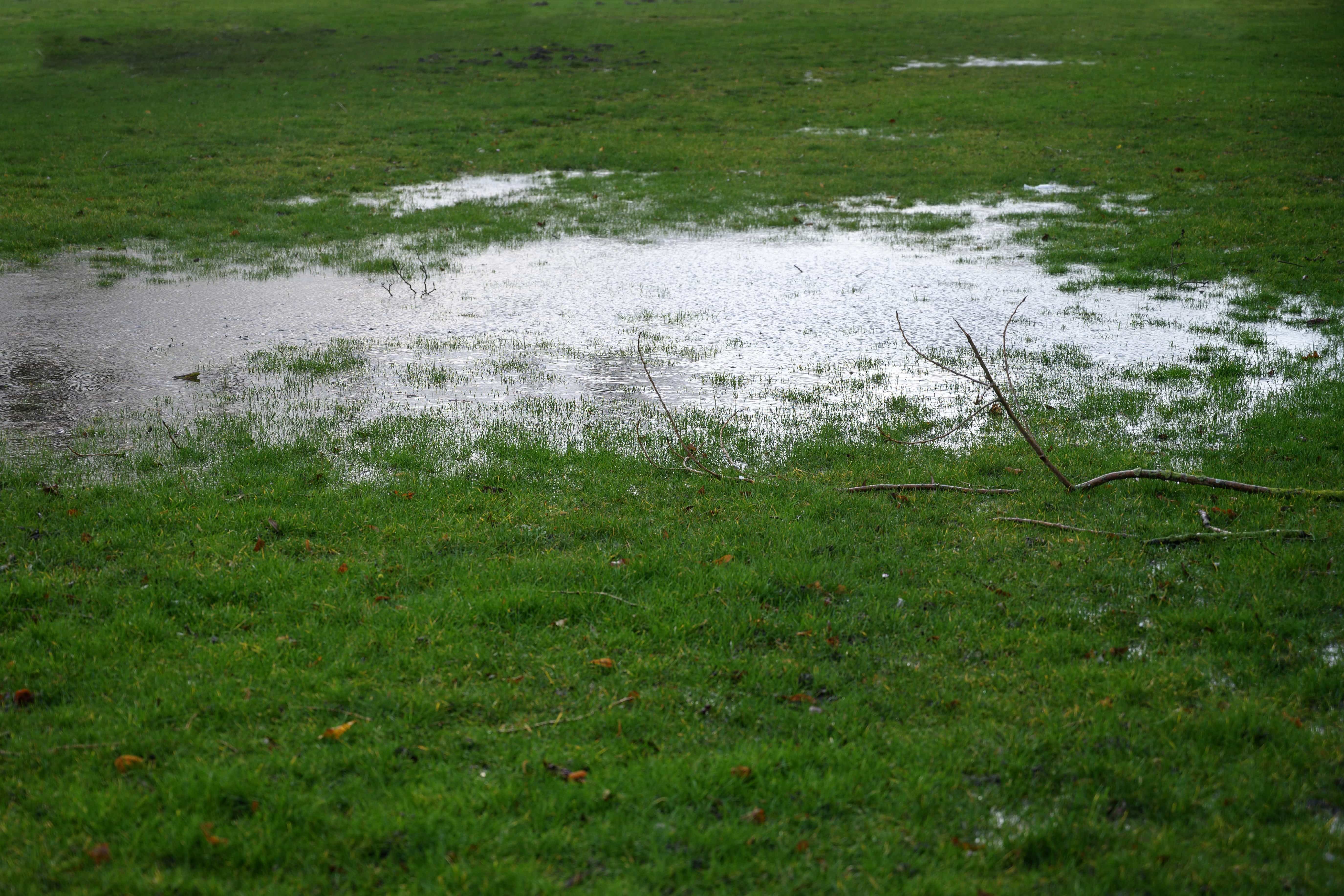
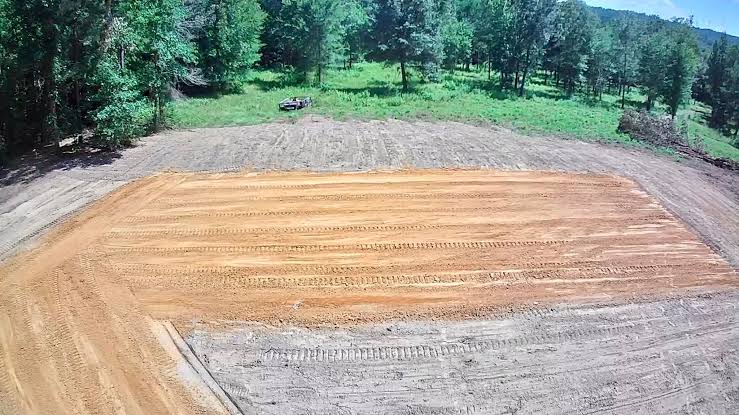
A yard may look flat to the naked eye while remaining a functional failure. Most builders stop at a "rough grade," which often contains tire ruts and equipment tracks that hold water in micro-pockets. These inconsistencies prevent a uniform sheet flow of runoff.
A functional finish grade requires a minimum 2% slope, which equates to a 1/4-inch drop per foot of distance. This is the baseline required to overcome the natural friction of grass, thatch, and soil.
The Technical Standard:
Manual "eyeballing" often misses subtle high spots that act as dams.
GPS-guided blades ensure a continuous fall to the designated exit point or swale.
Precision is required to ensure water moves at a predictable rate without causing erosion.
Why the "More Dirt and Seed" Strategy Always Fails
A common mistake involves dumping uncompacted topsoil into a low spot and applying seed. This approach treats the symptom without addressing the hydraulics of the site. Adding loose dirt over a drainage problem creates "mud in a box" where the water remains trapped beneath the new layer.
The new grass typically dies within a single season. The roots stay submerged in anaerobic, saturated soil, causing them to rot. To fix a low spot, the high spots must be cut to create a clear flow path before any growing medium is applied. Structural clarity comes from removing obstructions, not just layering material.
Subgrade Memory and the "Pumping" Soil Reality
When the ground bounces or "pumps" under foot traffic or machinery, the soil structure has collapsed due to saturation. This indicates that the subgrade—the foundation of your yard—is no longer capable of supporting weight or shedding moisture.
Field Signs:
Deep ruts from a standard lawnmower.
A "wave" of soil that moves ahead of equipment tires.
Grass that remains wet days after the rest of the neighborhood has dried.
Spot Repair vs. Full Stabilization
In cases of extreme saturation, undercutting becomes necessary. This involves removing the unstable "muck" and replacing it with structural fill or clean rock. In some profiles, a woven geotextile fabric is used to provide separation, preventing new finish dirt from sinking into the soft clay subgrade. If the soil is pumping, no amount of surface grading will provide a permanent fix until the subgrade moisture is managed.
The Role of GPS Grading in High-Stakes Drainage
On complex lots, GPS technology is used to create a digital contour map that identifies exit points invisible to the human eye. Applying B2B roadway prep logic to residential sites ensures that water moves away from buildings at a predictable, engineered rate.
This level of precision eliminates "dead spots" where mosquitoes and water-loving weeds thrive. Utilizing GPS Grading and Site Prep services ensures that the final surface matches the engineered drainage plan, reducing warranty callbacks and long-term maintenance costs.
Decision Guide: Is it a Surface Puddle or a Subgrade Crisis?
Symptom | Probable Cause | Corrective Action |
Water is gone in <12 hours | Minor surface tension or thatch | Core aeration or light top-dressing |
Water sits for >48 hours | Slope failure or rough grade defect | Mechanical finish grading |
Ground "bounces" when walked on | Saturated subgrade (Pumping) | Undercutting or stabilization |
Water follows foundation line | Backfill settlement | Foundation regrading and compaction |
When to Call a Sitework Contractor
A professional evaluation is necessary when "hand-raking" and repeated seeding have failed to solve the ponding issue. It is critical to address these failures before installing expensive irrigation systems or sod.
Specific triggers for a contractor include:
Water seeping through basement cove joints or window wells.
The need for a certified "proof-roll" to ensure stability for a new driveway.
Visible erosion where water is cutting a path through the yard.
This is where undercutting, stabilization, or drainage correction becomes necessary to protect the property's structural integrity.
Frequently Asked Questions
Can I just add more rock to the wet area?
No. Rock without a filter fabric or a graded exit point creates a "sump" that holds more water against the soil. It often exacerbates the saturation of the surrounding clay.
How long does finish grading take?
Most residential lots can be mechanically graded in one to two days. If subgrade stabilization is required for wet Kansas City clay, the timeline will extend to allow for soil correction.
What is a "proof-roll" and why does it matter?
A proof-roll involves driving heavy equipment over the grade to check for deflection. If the soil moves or "pumps," it is not stable enough for finish work or permanent structures.
Does finish grading include the seed?
Finish grading is the mechanical preparation of the soil. While seeding is the final step, the grading is the structural component that ensures the seed and the site remain viable.
Why does the water keep coming back after I fill the hole?
If you fill a hole without changing the slope of the surrounding area, the water will simply move to the edge of the new dirt. You must create a continuous path to a lower exit point.
More Articles


Load More