
The best gravel for clay soil driveways is not a single product. It is a layered build: geotextile fabric over a shaped subgrade, a compacted AB-3 base, and a clean limestone wearing course. On Kansas City clay, that structure decides whether the rock stays put or works into the mud within a few seasons. The same sequence applies whether the project is a small parking pad or full gravel driveway construction on a long private road.
Why Gravel Disappears Into Kansas City Clay
Most of the Kansas City metro sits on expansive clay. It is moisture sensitive: firm when dry, soft when saturated. Under wheel loads, wet clay does two things at once. Stone punches down into the subgrade, and clay fines pump up between the stones. Over a wet season, the gravel layer becomes a clay and rock mix that holds water, ruts, and turns slick in the rain.
Freeze-thaw makes it worse. Water trapped in a contaminated base freezes, expands, and heaves the surface, then leaves it loose when it thaws. That is why rock added in the fall can look rough by April.
The Best Gravel for Clay Soil Driveways Is a Layered System
Strip and shape the subgrade
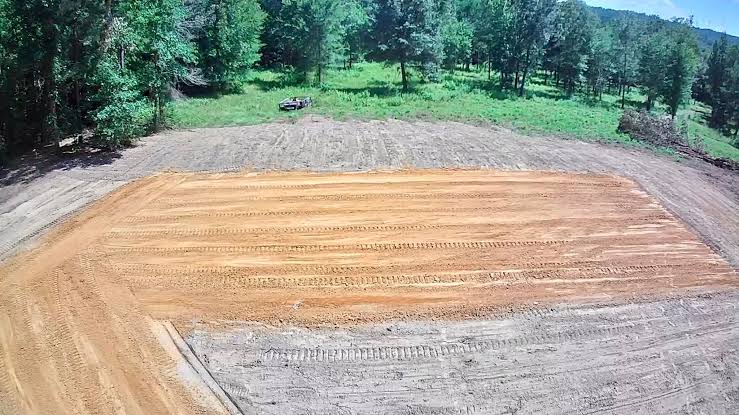
Topsoil and organic material come out first. Organic soil holds water and never compacts reliably. The exposed clay is shaped with a crown, a slight high point down the centerline, so water sheds to the edges. This is land grading at driveway scale, and it controls how the surface handles water long term.
Geotextile fabric over the clay
Woven geotextile fabric separates the clay from the rock. Water passes through it. Clay fines and stone do not. On soft or wet ground, fabric keeps the base clean instead of half clay within a few seasons. It also reduces the total rock needed, because stone stops sinking into the subgrade.
An AB-3 base, compacted in lifts
AB-3 is the base rock most Kansas City area quarries sell. Other regions call it crusher run or dense grade aggregate. It is crushed limestone graded from about 1 inch down to stone dust. The fines fill the voids between larger stone, so the layer locks into a hard, tight base when compacted. A typical residential drive on clay needs 4 to 6 inches of compacted AB-3. Drives that carry delivery trucks or equipment need more depth, placed and compacted in lifts rather than dumped in one pass.
A clean limestone wearing course
The top 2 to 3 inches is the wearing course. One inch clean limestone is the standard choice. Clean means screened, with no fines, so it sheds water and does not turn to paste in the rain the way exposed AB-3 fines can. The wearing course is not structure. It is the surface layer that gets topped up every few years while the base does the work.
AB-3, KGE, or Clean Limestone: What Each One Does
These limestone products look similar in a pile and behave differently on a driveway.
Material | What it is | Where it belongs | Where it goes wrong |
AB-3 | Crushed limestone graded from about 1 inch down to stone dust. The regional name for crusher run. | The compacted base layer. | Left exposed as a surface, its fines get sticky in the rain and dusty in the heat. |
KGE road rock | A harder eastern Kansas limestone with fewer fines. | A base or exposed surface on drives that need a tougher, cleaner rock. | It costs more than AB-3, which does the same structural job under a wearing course. |
1 inch clean | Screened limestone with no fines. | The wearing course on top of a compacted base. | Placed alone over clay, it punches straight into the subgrade. |
Large clean stone (2 to 4 inch) | Big, angular limestone. | A bridging lift over very soft or wet ground before base rock goes down. | Too coarse and loose to serve as a finished driving surface. |

Why a Compacted Base Still Needs Drainage
AB-3 compacts so tightly that it barely drains through itself. That is fine in a base layer, but it means water cannot soak down and away, and over clay it has nowhere to go anyway. Water has to leave across the surface. The crown, side fall, and edge ditching handle that.
A flat or dished driveway holds water against the base, the base passes it to the clay, and the clay softens under load the same way subgrade fails after rain on a construction site. Where a drive crosses low ground, a culvert matters as much as the rock.
Fixing a Muddy Driveway That Already Failed
The right fix depends on the condition of the base.
The surface ruts but the base is intact. Regrade, re-crown, and add a fresh wearing course. This is maintenance, not reconstruction.
Rock keeps disappearing and clay is pumping up. The base is contaminated. Adding more of the same rock buys one season. The lasting fix is to remove the failed material down to firm subgrade, lay fabric, and rebuild the layers.
Sections stay soft and wet year-round. Very soft ground needs a bridging lift of large, angular stone before base rock goes down, plus drainage work to cut off the water feeding the problem.
When a Gravel Driveway Is a Contractor Job
A short, flat drive over firm ground is a reasonable DIY project with a rented plate compactor. Length, slope, water, and truck access change the math. Long private roads, drives that cross drainage paths, entrances that need culverts, and ground that stays wet require equipment that can cut grade, move material in quantity, and compact in lifts. Building it once correctly costs less than topping off a failing drive every spring.
Frequently Asked Questions
What is the best gravel for a driveway on clay soil?
A layered system, not one product. Compacted AB-3 base rock over geotextile fabric, topped with 1 inch clean limestone, holds up on Kansas City clay. The base and fabric matter more than the surface stone.
What is AB-3 gravel?
AB-3 is crushed limestone graded from about 1 inch down to fines, sold across the Kansas City area as base rock. Other regions call the same product crusher run. It compacts into a hard, tight base layer.
Do I need fabric under a gravel driveway?
Over clay, yes in most cases. Woven geotextile keeps the stone and the clay separated, which stops the base from being contaminated. It is one of the cheapest line items in the build and one of the most valuable.
How thick should gravel be over clay soil?
Plan on 4 to 6 inches of compacted base rock plus 2 to 3 inches of wearing course for a residential drive. Heavier traffic or soft ground calls for a deeper base placed in compacted lifts.
Why does my gravel driveway keep sinking?
The stone is punching into saturated clay while clay fines pump up into the rock. More gravel treats the symptom for a season. Separation fabric, a rebuilt base, and surface drainage treat the cause.
Get a Quote for Your Gravel Driveway
A gravel driveway on clay holds up when the subgrade, fabric, and base are treated as part of the build. If a drive is long, wet, sloped, or already failing, have a contractor evaluate the subgrade and drainage before ordering more rock. ICON Grading & Construction builds and rebuilds gravel driveways and private roads across Eastern Jackson County and the Kansas City metro.
Call ICON at (816) 867-5134 or request a quote today.
More Articles

Load More