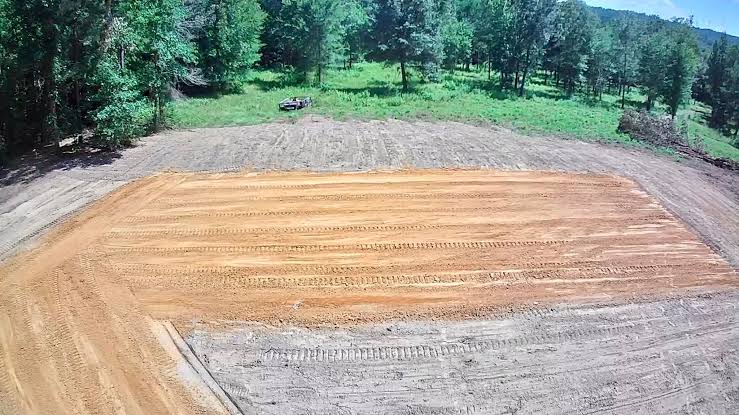
The building went up straight. Two springs later the overhead door binds in its track, a crack runs from one corner of the slab toward the middle, and water comes in under the door in a hard rain. The building is fine. The pad under it is not. Site prep for a shop or pole barn is where these problems start, and on Kansas City clay it is the line item owners underbuy.
What Site Prep for a Shop or Pole Barn Actually Includes
Most building companies quote the structure and leave one sentence in the contract: site must be level and ready. That sentence covers five operations.
Clearing and stripping: Trees, brush, and every inch of topsoil out of the pad area.
Cut and fill: Moving dirt to a designed pad elevation, not just a flat spot.
Moisture conditioning and compaction: Fill placed at a workable moisture, in controlled layers.
Pad shaping: Fall built into the surface so water leaves in every direction.
Base and finish grade: Compacted aggregate under the slab, then tying the pad into the ground around it.
Skip one and the building still goes up, it just doesn’t stay square.
Why Kansas City Clay Moves Under a Shop Slab
The clay across Jackson, Clay, Cass, and northern Johnson counties is a high-plasticity soil. It holds water and changes volume as the water content changes. Wet, it swells. Dry, it shrinks and cracks open.
A shop slab rarely fails because the ground could not carry the weight. Kansas City clay holds a 40x60 building without complaint. It fails because the soil under one part of the slab got wetter than the soil under another, and the two moved by different amounts. A slab cannot bridge that. It cracks instead.
Winter compounds it. Freeze-thaw cycles pull moisture toward the surface and leave the section softer in February than it was in December. It is the same mechanism that leaves subgrade solid under a loaded truck one week and pumping the next, and it shows up under shop pads too.
Build the Pad Up, Do Not Cut It In

The most expensive mistake in shop site prep is carving a flat spot into a hillside.
Cutting is cheaper than importing fill, and the surface comes out level, which is what the building company asked for. The problem is water. A cut pad sits at the low point of everything uphill of it, so runoff routes toward three sides of the building and ends up under the door.
A pad that works is built above the surrounding ground, not into it.
The pad surface sits high. Finish elevation above the grade around it.
Fall runs in every direction. Code calls for six inches of drop in the first ten feet and two percent across paved surfaces. Treat that as the floor.
Uphill water gets intercepted. A swale or berm above the pad turns runoff before it reaches the building.
Decide this before ordering the building. It sets the fill quantity, the largest variable in the price.
How Big the Pad Needs to Be
The pad is always larger than the building, and the reason is structural. A slab edge cannot sit on the sloped shoulder of the fill. Fill slopes are the least confined part of any pad, and a slab edge bearing on one will settle. The pad has to run flat far enough past the footprint that the edge is fully over compacted material, then break to slope. Four feet on every side is the common builder standard.
Working room is the other reason. A pad cut tight to the footprint leaves the crew nowhere to stand and no room for a concrete truck, which needs a route in that holds weight when wet. If the drive is part of the project, the gravel section under it matters as much as the pad.
Whether the Clay You Dig Out Can Be Used as Fill
Every article on this topic gives a different answer. One says clay is unsuitable and to haul in granular. The next says clay is fine. Both skip the variable that decides it: how the clay gets placed.
Approach | What happens on Kansas City clay |
|---|---|
Clay pushed into place and tracked | Looks solid on day one. Finds its own density over two wet seasons. The slab settles unevenly. |
Clay moisture conditioned, placed in lifts, compacted and tested | Performs. Usually the cheapest option when the moisture is workable. |
Imported granular fill | Predictable and faster in a wet season. Higher material and hauling cost. |
Topsoil left in place under the pad | Organics break down and leave voids. Soft spots appear no matter what goes above. |
Three things separate the second row from the first.
Topsoil comes out first. All of it, across the full pad. Organics decompose and leave voids no compaction above them will fix.
Fill goes in thin layers. Clay densifies only so far from the surface down. Lifts of six inches or less, each compacted before the next goes on, is the difference between a pad and a pile.
Moisture gets managed. Kansas City clay compacts only within a narrow band around its optimum moisture. Too wet and it pumps under the roller. Too dry and the lifts never bond. Compaction gets verified against a Proctor test, generally 95 percent of standard Proctor, not judged by eye.
That window is why season matters more here than in sandier markets. Late summer into fall is the most workable stretch for clay in this metro. Spring is the hardest, and a wet April carries real schedule risk.
What Goes Under the Slab or Gravel Floor
Once the subgrade is right, the base is straightforward. Once it is wrong, no base depth fixes it.
For a concrete floor, the section is four to six inches of compacted AB-3 over the prepared subgrade, with a vapor barrier under any shop that will be heated or finished. The base spreads load and separates the slab from a material that changes volume. For a gravel floor, the base is the floor, so depth and material carry more weight.
Uniformity matters more on clay than on sand. A base eight inches thick in one place and four in another gives the slab two different support conditions, exactly the differential it cannot absorb. Building pad grading on a commercial pad gets measured and verified for that reason. A shop pad deserves the same.
A Shop Pad Is a Shape, Not a Flat Spot
A finished pad is a designed surface with fall running away from the building on every side and an elevation that holds across the full width. On a 40x60 building the graded surface runs close to 50 by 70 feet, and holding a consistent slope across that off stakes is slow.
GPS machine control loads the design into the machine and holds the surface directly. Fewer passes, tighter grade, and a pad that drains the way it was drawn. On a shop pad that means a shorter day on site and a surface the concrete crew does not have to rework.
When to Call a Contractor for Shop or Pole Barn Site Prep
Some pads are a weekend with a rented skid steer. Most are not. Call a contractor when any of these is true.
The ground slopes toward the building: A built-up pad on a grade has to be designed, not eyeballed.
The pad needs more than a foot of fill: Depth is where lift control and compaction testing stop being optional.
The concrete is going in the same season: Pouring on a pad that was never properly compacted is an expensive way to find out.
The quote says level and ready: The building company is not doing site work.
The pad under a shop decides whether the doors still latch in ten years. ICON Grading & Construction has built pads, drives, and drainage on eastern Jackson County clay since 2015, owner-operated out of Grain Valley.

Frequently Asked Questions
How thick should a gravel pad be for a pole barn?
Four to six inches of compacted AB-3 is a reasonable starting point on prepared subgrade, with more under a shop carrying equipment or a lift. Subgrade condition drives the number, not building size.
Do I need to remove topsoil before building a shop pad?
Yes, across the full pad rather than just the footprint. Topsoil holds organic material that decomposes and leaves voids, and compaction above it does not prevent that.
Can you build a shop on clay soil?
Yes. Kansas City clay carries a shop building without difficulty. The work is in managing moisture and drainage so it does not swell and shrink unevenly under the slab.
How much bigger should the pad be than the building?
About four feet on every side is the common standard. That keeps the slab edge over compacted material rather than the fill slope, and leaves the crew room to work.
What time of year is best for site prep in Kansas City?
Late summer through fall is usually the most workable window, because clay moisture sits closer to what compacts well. Spring is the hardest and most likely to lose days to weather.
For a shop, barn, or metal building pad anywhere in the Kansas City metro, call ICON at (816) 867-5134 or request a quote today.
More Articles



Load More