
Clearing and grubbing is the first site work on a wooded building lot. Clearing removes trees, brush, and debris above ground. Grubbing removes the stumps, roots, and buried wood below it.
Grubbing is the part that decides whether a slab or foundation stays level. Wood left in the ground rots and the soil above it settles, and on Kansas City clay that settlement is uneven enough to crack concrete.
Where Grubbing Usually Gets Skipped
The usual shortcut is to haul off the trees, grind the stumps flush, and call the site clear. That handles clearing and skips most of the grubbing.
It also falls short of code. The International Residential Code, the model code Kansas City-area cities adopt for houses, requires all vegetation, topsoil, and foreign material to be removed from the area inside the foundation walls, and any fill placed there to be free of vegetation. Ground stumps with their roots in place inside the footprint do not meet that standard.
A third step, stripping, removes the topsoil and the root mat in it. It is covered in the guide to topsoil stripping and pad fill.
Why Buried Roots and Stumps Settle Under a Slab
A stump cannot be compacted. It carries load until it rots, then loses volume, and the soil and slab above it drop into the space.
Decay is slow. A large stump can take years to break down, so settlement usually shows up after the house is finished and the site work is long done. The cause is rarely traced back to the clearing.
Kansas City clay adds a second problem. The metro's clay is high plasticity: it swells when wet and shrinks when dry. Decaying root channels carry water into the surrounding clay and create wet pockets that move more than the soil a few feet away. A slab tolerates ground that moves evenly. It cracks when one area drops or heaves and the rest does not. This is differential settlement, and it shows up as cracked floors, sticking doors, and gaps at the foundation.
Stump Grinding vs Removal Inside the Building Footprint
A grinder cuts the stump below the surface and leaves the root system in place. On a mature tree, that is a large share of the wood below grade, and it decays where it sits.

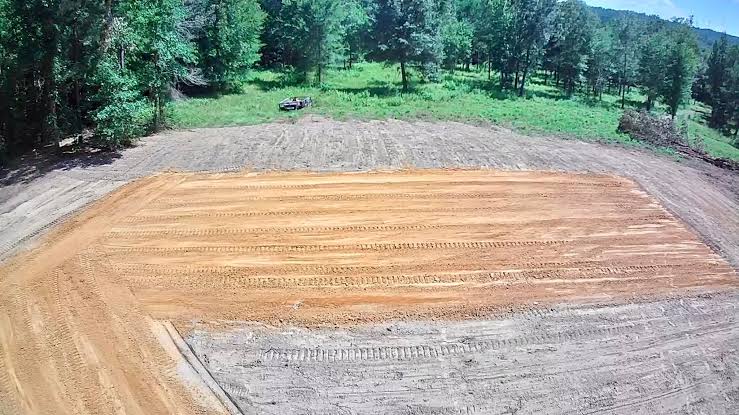
In lawns and landscape beds, the result is a minor dip at most. Inside the house or shop footprint, the pad shoulders, the driveway, and utility routes, the stump comes out whole with an excavator and the major roots are dug out with it. Grinding chips stay out of those areas too, since they are the same organic material in smaller pieces.
Why Filled Stump Holes Sink in Kansas City Clay
Removing a stump leaves a hole that can be several feet across. The quick way to fill it is to push loose soil in and track over it. The surface looks finished, but the loose fill settles over the next few wet seasons, and each hole becomes a soft spot.
Kansas City clay compacts properly only within roughly two percentage points of its optimum moisture content. Wetter than that, it pumps under the roller, the same behavior that makes subgrade pump after a hard rain. Drier, the layers do not bond. Soil pushed into a hole at whatever moisture it happens to have usually misses that range. Metro clay is most workable from late summer through fall and least workable in spring.

Inside the pad area, each hole is backfilled as structural fill:
Clean the hole. Remove remaining roots and loose soil down to firm native ground.
Condition the fill. Bring it to a workable moisture before placing it.
Place thin lifts. Six inches or less, each compacted before the next.
Verify density. 95 percent of standard Proctor, the lab test that sets the target density for that soil, with test results recorded for each hole under the pad.
Burial Pits: What a Previously Cleared Lot Can Hide
Burying stumps on site avoids hauling them, and on many rural lots cleared years ago, a pit of stumps and logs is still in the ground. It settles the same way a single stump does, on a larger scale, and can keep settling for years.

Previous owners, neighbors, or whoever did the original clearing may know where debris was buried. Unexplained low spots and old fill mounds are other signs. The reliable check is a few excavator test pits across the planned footprint before the building is staked. A pit found under a planned house, shop, or drive is dug out completely and backfilled in compacted lifts. Adding fill or base rock over it does not stop the settlement.
What a Clearing and Grubbing Scope Should Include Before You Build
Clearing a lot to build a house is often quoted as a single line item. These five questions show what the quote covers below grade.
How far do the grubbing limits extend? The full pad, about four feet past the footprint by the common builder standard, plus the drive and utility routes.
Where do stumps and debris go? Hauled off site.
How are the holes backfilled? Compacted lifts at controlled moisture, with density test results you can see.
Is the topsoil stripped? Across the full pad.
Who grades the pad afterward? If land clearing and building pad grading are separate contracts, confirm which one covers the grub holes.
When to Call a Contractor for Clearing and Grubbing
Bring in an excavation contractor before the trees come down when the lot is wooded where the house, shop, or drive will go, when the property was cleared by someone else in the past, or when construction is planned for the same season as the clearing. ICON Grading & Construction has cleared, grubbed, and graded building sites across the Kansas City metro since 2015.
Frequently Asked Questions
How deep does grubbing go?
There is no single depth. Inside a building footprint, pad, or drive, grubbing goes as deep as the stump and major roots go, and the hole is then backfilled in compacted lifts. Highway specifications set minimum removal depths for road embankments, but those are written for roads, not slabs and foundations.
Is topsoil stripping part of clearing and grubbing?
Not always. Some contractors quote stripping as a separate line item, and some leave it out. Under a building, the topsoil comes off across the full pad, so confirm it is in the written scope.
Do you need a permit to clear land in the Kansas City area?
Disturbing one acre or more requires a construction stormwater permit, issued by the Missouri Department of Natural Resources on the Missouri side and by the Kansas Department of Health and Environment in Kansas. Many cities and counties also require their own grading or land disturbance permits, including for smaller sites, so check with the local building or public works department before clearing starts.
What equipment is used for clearing and grubbing?
Excavators with a thumb or grapple pull stumps and root balls, and dozers push and pile cleared material. Root rakes sift roots out of the soil without hauling the soil away with them.
Should stump holes be filled with clay or rock?
Either works when placed correctly. On-site clay has to go in thin lifts close to its optimum moisture, while imported granular fill is more predictable in a wet season. Loose fill of either kind will settle.
Call ICON at (816) 867-5134 or request a quote at icongrading.com.
More Articles

Load More